Car AC Not Cooling in Abu Dhabi? 7 Causes, Fixes & Repair Costs (2026)

When a car AC stops cooling in Abu Dhabi, the cause is almost always one of seven faults. These are low refrigerant from a leak, a failing compressor or clutch, a condenser clogged with dust and sand, a dead cooling fan, a blocked expansion valve, an electrical fault, or a stuck blend door. A pressure test and leak check identify the culprit before any parts are replaced.
Key takeaways
- Refrigerant does not get used up. If your system is low, it has a leak. Topping up without fixing the leak usually buys you weeks, not months.
- Abu Dhabi conditions are tough on AC systems. Summer temperatures regularly pass 45°C, and fine sand packs into the condenser. Both force the system to work at its limit.
- Where it fails tells you a lot. An AC that cools on the highway but turns warm in traffic usually points to the cooling fan or condenser. Warm air at every speed points to refrigerant or the compressor.
- Typical UAE market ranges (2026): a regas costs roughly AED 150–600. A compressor repair or replacement costs roughly AED 850–5,000+, depending on the car.
- Newer cars often use R1234yf refrigerant instead of R134a. It is more expensive and needs different equipment. The label under your bonnet tells you which one your car uses.
How does a car AC system work?
Your car's AC moves heat from inside the cabin to the outside air in a sealed loop:
- The compressor, driven by the engine or an electric motor, pressurises the refrigerant.
- The condenser at the front of the car releases that heat into the outside air.
- The expansion valve (or orifice tube) drops the pressure, which makes the refrigerant very cold.
- The evaporator behind the dashboard absorbs heat from the cabin air.
- The blower fan pushes the cooled air through your vents.
If any link in that chain fails, cooling drops. In the UAE, the condenser has to shed heat into air that is already 45°C or hotter. That is why small faults that go unnoticed in milder climates show up quickly here.
The 7 most common reasons a car AC stops cooling
1. Low refrigerant caused by a leak
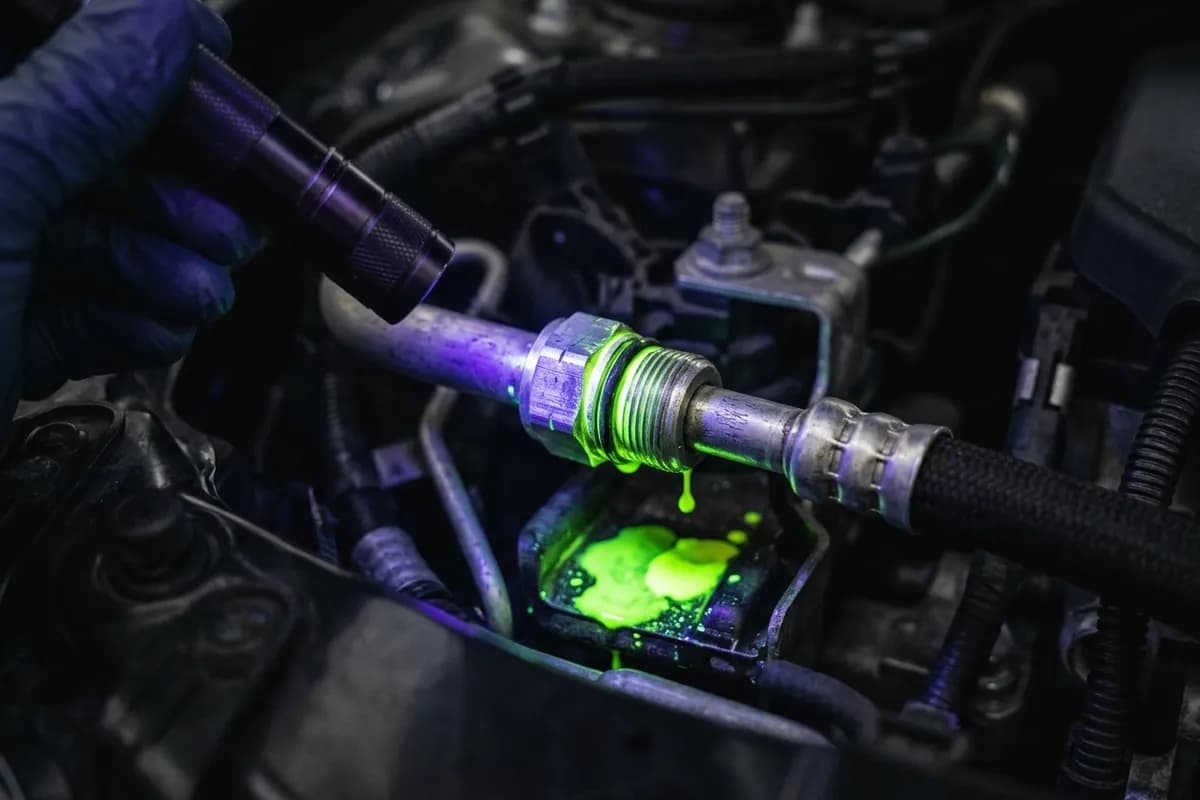
Signs: Cooling gets weaker gradually over days or weeks. You may hear a faint hissing, or see oily residue around AC pipe joints.
Why it happens: The usual leak points are:
- the condenser, which takes stone chips at the front of the car
- perished O-rings at pipe joints
- service-port valves
- the compressor shaft seal
- occasionally the evaporator
The proper fix: Find the leak with UV dye or an electronic leak detector, repair it, pull a vacuum on the system, then recharge it with the exact refrigerant weight on the car's specification label.
2. Compressor or compressor clutch failure
Signs: No cold air at all, a grinding or rattling noise when you switch the AC on, or a compressor clutch that never engages.
Why it happens: A slow leak also carries away the oil that lubricates the compressor, so a compressor running low on refrigerant wears quickly. Age and heat do the rest.
The proper fix: Replace the compressor. Flush the system, and renew the receiver-drier (or accumulator) and expansion valve where needed. Skipping the flush leaves metal debris in the system that can destroy the new compressor.
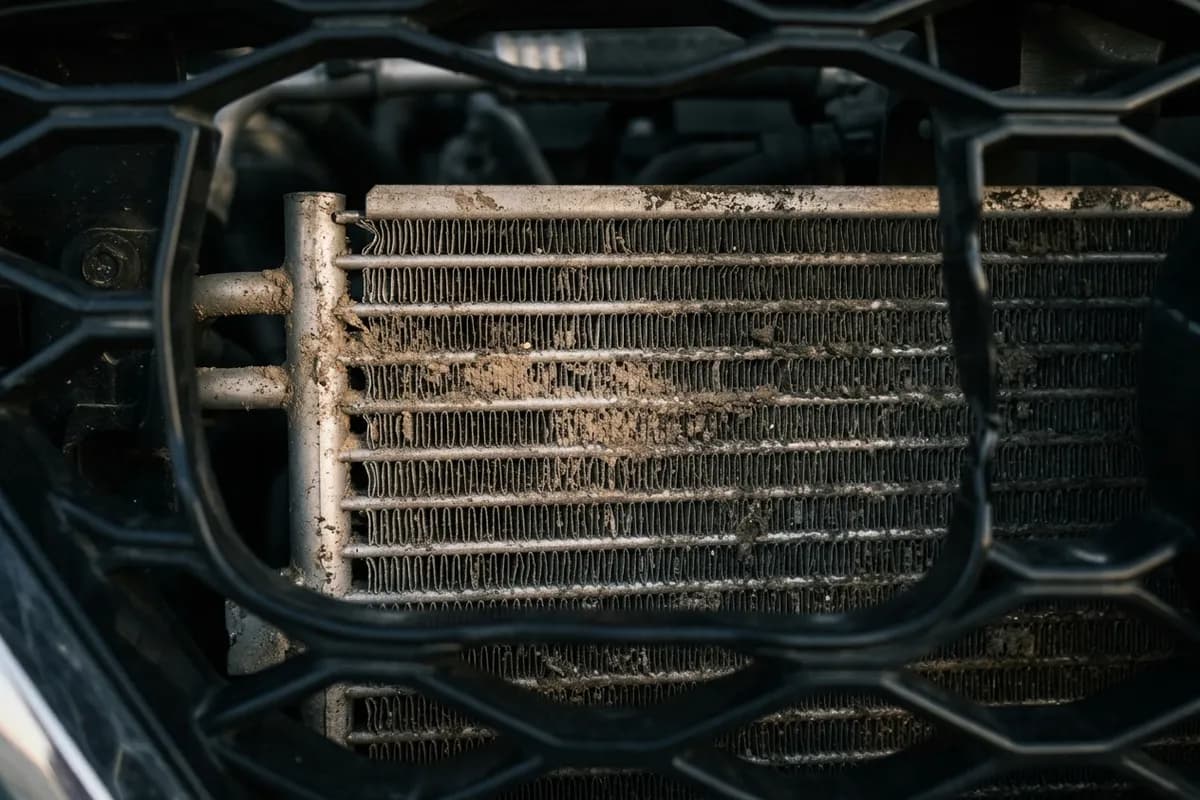
3. Condenser clogged with sand, dust or debris
Signs: The AC cools well on the open road but turns warm in traffic or at idle.
Why it happens: UAE driving packs the condenser fins with fine sand, dust, insects and road grime. Airflow drops, the condenser can no longer release heat, and system pressure climbs.
The proper fix: A careful low-pressure clean if the fins are intact, or a replacement if they are corroded or damaged.
4. Cooling fan failure
Signs: The AC is warm at idle and in traffic but recovers when you drive. Sometimes the engine temperature also creeps up in slow traffic.
Why it happens: The electric fan pulls air through the condenser and radiator when the car is not moving fast enough to force air through. A failed fan motor, relay, fuse or fan control module stops this.
The proper fix: Test the fan circuit and replace the failed part. If your temperature gauge is rising too, read our guide to diagnosing overheating and coolant leaks. Overheating can cause expensive engine damage.
5. Blocked expansion valve or orifice tube
Signs: Cooling comes and goes, AC pipes frost over, or the gauges show abnormal pressures.
Why it happens: Moisture or debris in the system restricts the valve, so refrigerant flow becomes erratic.
The proper fix: Replace the valve, evacuate the moisture with a proper vacuum, and recharge the system.
6. Electrical faults
Signs: The AC suddenly stops working altogether, or works only some of the time, often with no noise at all.
Why it happens: Modern cars will not engage the compressor if a pressure sensor, temperature sensor, relay, fuse or control module reports an out-of-range value. This is a safety feature, but it means one cheap sensor can switch off the whole system.
The proper fix: Scan the fault memory with computer diagnostics, then test the circuit. Our electrical repair team handles wiring and module faults.
7. Blend door actuator or airflow problems
Signs: One side of the cabin blows cold while the other blows warm. You hear clicking behind the dashboard, the temperature setting changes nothing, or airflow is weak even on full fan.
Why it happens: A failed blend door actuator keeps letting heater air mix in. Weak airflow is often caused by a clogged cabin filter or a failing blower motor.
The proper fix: Replace or recalibrate the actuator, replace the cabin filter, or test the blower motor and its resistor or control module.
Symptom checker: what is your AC telling you?
| What you notice | Most likely cause | What to do |
|---|---|---|
| Cold on the highway, warm in traffic or at idle | Cooling fan or blocked condenser | Book a check soon. Watch your engine temperature. |
| Cooling gets weaker over days or weeks | Refrigerant leak | Book a leak test before the compressor is damaged |
| Suddenly warm, with a grinding or rattling noise when AC is on | Compressor or clutch failure | Switch the AC off and book now |
| Engine temperature rising and AC warm | Cooling fan failure | Stop safely and call for help |
| One side cold, the other warm | Blend door actuator | Low urgency. Book when convenient. |
| Weak airflow even on maximum fan | Cabin filter or blower motor | Low urgency. Often a quick fix. |
| Musty smell from the vents | Bacteria on the evaporator or a dirty filter | Filter change and evaporator clean |
How much does car AC repair cost in Abu Dhabi?
The prices below are typical UAE market ranges based on published workshop pricing in 2026. Your exact cost depends on your car, its refrigerant type and the parts needed. European luxury models such as BMW, Mercedes-Benz, Porsche and Range Rover usually sit at the upper end because of part prices and labour access.
| Repair | Typical UAE range (AED) |
|---|---|
| Diagnostic / pressure check | 150–400 |
| Cabin filter replacement | 50–250 |
| AC regas (R134a) | 150–600 |
| AC regas (R1234yf) | 500–900+ |
| Leak test and repair | 250–1,500+ |
| Condenser clean, repair or replacement | 300–2,000+ |
| Compressor repair or replacement | 850–5,000+ |
| Evaporator repair or replacement | 1,500–6,000+ |
At Garage Bay you get an itemised quote before any work starts, so you approve the cost first.
Should you just "top up the gas"?
Only if a technician has confirmed there is no active leak. A top-up hides the problem without fixing it. It is also easy to overcharge a system when you add refrigerant by guesswork instead of by weight, and overcharging strains the compressor.
The correct procedure is to recover any remaining refrigerant, pull a vacuum to remove moisture, then charge the exact amount on the car's specification label. R134a and R1234yf systems use different equipment and must never be mixed.
How to keep your car AC healthy in the UAE
- Run the AC regularly, even in the cooler months. This keeps the seals lubricated and stops them drying out.
- Vent the cabin before you cool it. Open the windows for the first minute after parking in the sun so the AC is not fighting trapped hot air.
- Use shade and a windscreen sunshade whenever you can.
- Replace the cabin filter regularly. Do it at least once a year, and more often if you drive in dusty areas.
- Ask for a condenser inspection and clean at your annual service.
- Act on small drops in cooling early. A leak repair costs far less than a compressor.
Car AC repair at Garage Bay, Abu Dhabi
At Garage Bay, every AC job starts with a proper diagnosis: pressure readings, leak detection and a fault-memory scan, before any parts are quoted. Major repairs such as compressor and condenser replacement are carried out at our climate-controlled workshop in Mussafah Industrial Area M-14. Our doorstep team covers Abu Dhabi for inspections.
All work is covered by our 12-month / 20,000 km warranty. Find out more about our car AC repair service, our Musaffah AC repair workshop, or Ford AC repair.
Need Immediate Diagnostic Assistance in Abu Dhabi?
Our 24/7 mobile response vans carry PIWIS 3, XENTRY, and ISTA+ factory diagnostic computers directly to your villa or parking tower in 20 minutes.
Frequently asked questions
Q: Why does my car AC cool while driving but not at idle?
This almost always points to airflow over the condenser. At speed, air is forced through the condenser naturally. At idle, the car depends on the electric cooling fan. A failed fan, relay or fan module, or a condenser clogged with sand, causes warm air in traffic. A technician can confirm which one with a pressure test.
Q: How often should a car AC be regassed in the UAE?
A healthy AC system is sealed and should not need a routine regas. A very small loss over several years is normal, but if your car needs refrigerant every few months, it has a leak. Fixing the leak and recharging by exact weight is cheaper in the long run than repeated top-ups.
Q: Can I keep driving with a faulty AC compressor?
If the compressor is noisy or seized, switch the AC off and have it checked quickly. On belt-driven compressors, a seized pulley bearing can damage the drive belt. That belt often also drives the alternator and other parts, so the fault can leave you stranded.
Q: How long does a car AC repair take?
A regas usually takes about an hour. Leak detection and simple repairs are often completed the same day. A compressor replacement with a system flush typically takes most of a day, depending on parts availability for your model.
Q: Does my car use R134a or R1234yf refrigerant?
Check the AC specification label under the bonnet, usually on the slam panel near the radiator. It lists the refrigerant type and the exact charge weight. Many newer cars use R1234yf, which costs more and needs dedicated equipment. The two refrigerants must never be mixed.
الأسئلة الشائعة
س: لماذا لا يبرد مكيف سيارتي في الصيف في أبوظبي؟
أكثر الأسباب شيوعاً هي نقص غاز التبريد بسبب تسريب، أو تعطل الكمبروسر، أو انسداد المكثف (الكوندنسر) بالغبار والرمل، أو تعطل مروحة التبريد. يحدد الفحص بأجهزة قياس الضغط وكشف التسريب السبب بدقة قبل استبدال أي قطعة.
س: كم تبلغ تكلفة تصليح مكيف السيارة في أبوظبي؟
تتراوح تعبئة غاز المكيف عادةً بين 150 و600 درهم تقريباً، بينما قد تكلف صيانة أو استبدال الكمبروسر بين 850 و5,000 درهم أو أكثر حسب نوع السيارة. يقدم كراج باي عرض سعر مفصلاً قبل البدء بأي عمل.
س: أين يتم إصلاح مكيف السيارة لدى كراج باي؟
تُنفذ الإصلاحات الكبيرة مثل استبدال الكمبروسر والمكثف في ورشتنا المكيفة في منطقة مصفح الصناعية M-14، ويغطي فريق الخدمة المتنقلة مناطق أبوظبي لإجراء الفحص في موقعك. جميع الأعمال مشمولة بضمان لمدة 12 شهراً أو 20,000 كم.
Sources
- Typical UAE AC repair price ranges: ArabWheels, "Car AC Not Cooling in UAE? Causes, Costs and Expert Fixes" (June 2026)